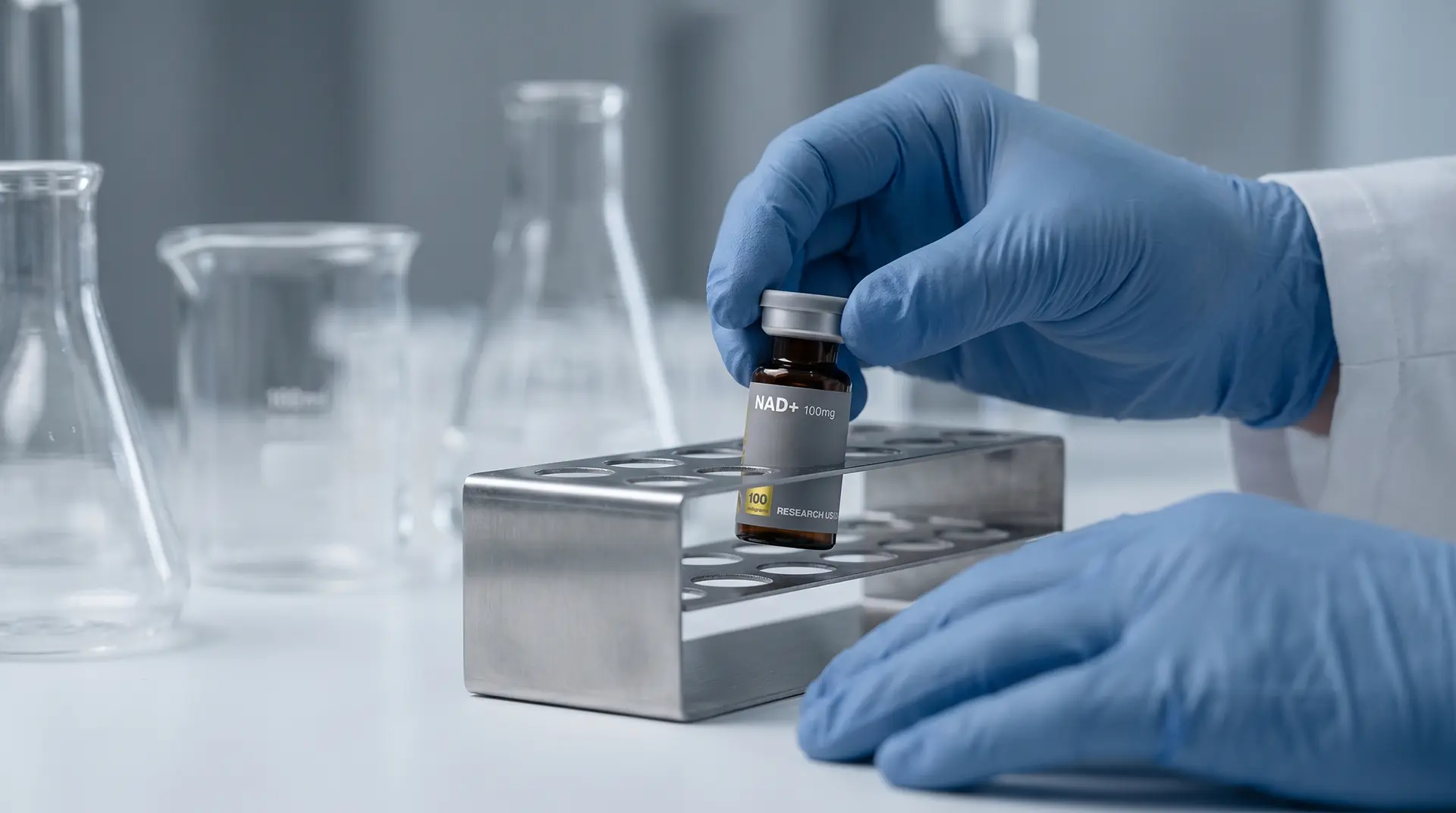
NAD+ (Nicotinamide Adenine Dinucleotide) is one of the most important coenzymes in cellular metabolism. It plays a central role in energy production, redox reactions, and metabolic regulation across nearly all living systems.
In laboratory research, NAD+ and related metabolic compounds are studied to better understand cellular energy pathways, mitochondrial function, and biochemical signaling networks.
This makes NAD+ a key focus in metabolic and systems biology research models.
What Is NAD+? NAD+ is a naturally occurring coenzyme found in all living cells. It functions primarily as an electron carrier, helping transfer energy during metabolic reactions. It exists in two forms: NAD+ (oxidized form) NADH (reduced form) NAD+↔NADH+e−+H+ This redox cycle is fundamental to energy production and cellular metabolism. The Role of NAD⁺ in […]
NAD+ is a naturally occurring coenzyme found in all living cells. It functions primarily as an electron carrier, helping transfer energy during metabolic reactions.
It exists in two forms:
NAD+↔NADH+e−+H+
This redox cycle is fundamental to energy production and cellular metabolism.
NAD+ is essential for converting nutrients into usable cellular energy.
It plays a key role in:
These pathways collectively support ATP generation, the primary energy source for cells.
In laboratory studies, NAD+ is used to investigate:
Researchers study how cells generate and regulate energy at the mitochondrial level.
NAD+/NADH ratios help maintain oxidative balance within cells.
NAD+ influences how cells process and respond to nutrients.
It acts as a cofactor for enzymes involved in DNA repair and metabolic regulation.
Mitochondria are the primary site of cellular energy production, and NAD+ is central to their function.
It helps:
Because of this, NAD+ is often studied in mitochondrial and metabolic dysfunction models.
In laboratory environments, NAD+ is commonly used in:
It is frequently combined with other compounds in multi-pathway metabolic research systems.
(→ Internal link: Multi-Compound Research Design Explained)
NAD⁺ levels in biological systems can be influenced by precursor molecules such as:
These compounds are studied for their role in supporting NAD+ biosynthesis pathways.
Beyond energy production, NAD+ also plays a role in cell signaling and regulation.
It is involved in:
These functions make NAD+ a key molecule in systems biology research.
As with all research compounds, NAD+ and related molecules require proper analytical validation.
Common methods include:
(→ Internal link: HPLC Testing & COAs)
NAD+ is sensitive to environmental conditions and must be handled carefully in laboratory settings.
Key stability factors include:
Degradation can reduce functional activity in experimental systems.
(→ Internal link: Storage & Stability)
NAD+ is often studied alongside other metabolic compounds to explore:
This makes it a core component of multi-compound metabolic research designs.
NAD+ and related research compounds used in laboratory settings fall under Research Use Only (RUO) classification.
This ensures:
(→ Internal link: RUO Standards)
NAD+ is commonly used in:
These applications help researchers better understand how cells regulate energy at a molecular level.
NAD+ is a foundational molecule in metabolic and cellular energy research, playing a critical role in redox reactions, mitochondrial function, and biochemical signaling.
Its involvement in nearly every aspect of cellular metabolism makes it one of the most important compounds studied in modern laboratory research.
When combined with other metabolic compounds, NAD+ helps researchers build more complete models of cellular energy systems and biological regulation.
Precision matters in research. Just Compounds is committed to delivering analytically verified compounds with consistency, transparency, and reliability.
All products available through Just Compounds are intended strictly for laboratory research purposes. These compounds are not approved for human consumption, veterinary use, therapeutic application, or diagnostic procedures. They are not classified as dietary supplements, drugs, or medical products. The information provided on this website is for educational and research purposes only and has not been evaluated by the U.S. Food and Drug Administration (FDA). Just Compounds is not a compounding pharmacy and does not operate as an outsourcing facility under sections 503A or 503B of the Federal Food, Drug, and Cosmetic Act. All materials must be handled by qualified professionals in accordance with applicable laws, institutional policies, and laboratory safety standards.

Just Compounds provides research peptides and specialty compounds exclusively for qualified researchers and laboratory use. Please confirm the following before continuing.
By proceeding, you confirm that the statements above are accurate. Products offered by Just Compounds are intended strictly for laboratory research and are not approved for human or veterinary use.